Phillip L. Clay, 2013
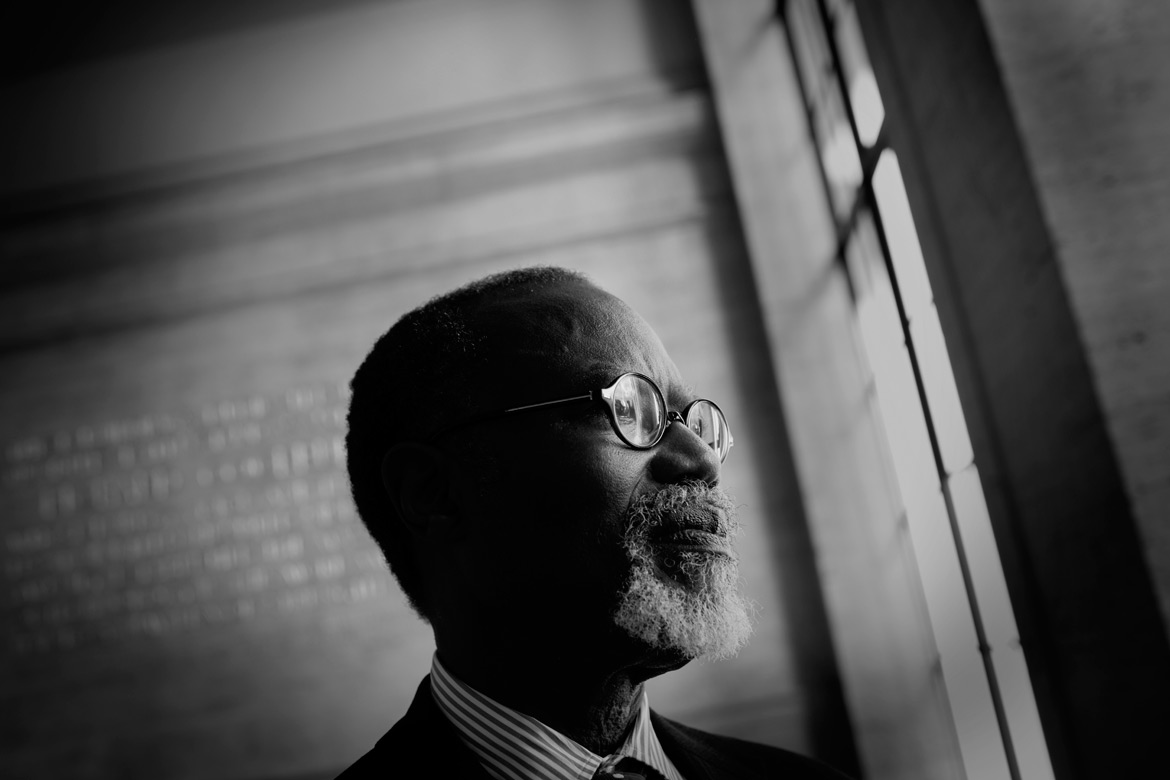
Phil Clay, who served in the U.S. Army from 1969 to 1971 and was the first African American to head a department at the Institute, shown here in Lobby 10 on Veterans' Day, 2013.
Professor Emeritus Phillip L. Clay PhD '75 served as the Chancellor of MIT from 2001 until 2011. He is a graduate of the University of North Carolina at Chapel Hill and holds a doctorate from MIT. Clay has also held other leadership positions at MIT and was Department Head in the Department of Urban Studies and Planning (DUSP), where he has been a faculty member since 1976.
Clay is widely known for his work in U.S. housing policy and urban development. His current interests include organizational capacity in community-based nonprofits as well as the role of anchor institutions. Growing out of his work on MIT international strategies, he is also interested in the increasing role higher education can play in national development strategies in less developed and emerging nations.
Clay is Chair of the Board of The Community Builders, Inc., one of the nation's largest nonprofit developers of affordable housing. He is a member on several foundation and nonprofit boards, including The Kresge Foundation and The MasterCard Foundation. Professor Clay also has experience in public higher education as a member of the board of the University of North Carolina. He is a member of the board of the Aga Khan University.
Presently in DUSP Clay teaches courses in housing policy and poverty. He also teaches Thesis Prep and head the Housing, Community and Economic Development Group.
Leadership
Under Clay’s leadership, MIT saw the number of applications for undergraduate admission double and also attracted students of increasing quality, diversity and breadth of achievement. Financial aid evolved to reinforce MIT’s values and enrollment goals, and to support diversity. The Institute advanced the educational commons through increased opportunities for global education, communications, project- and service-based activities, and through support for innovative courses across the curriculum.
Also during Clay’s tenure as chancellor, MIT greatly expanded graduate housing and supported improvements to graduate student life. The Institute added the Sydney-Pacific and Ashdown residence halls to create a graduate community in the Northwest sector. Simmons Hall came online for undergraduates, and several residence halls were upgraded. MIT enhanced support for fraternities, sororities and independent living groups by increasing staff support and services, leadership training and alumni engagement. Together with the Medical Department, the chancellor’s office developed a program of mental-health and student services. Support for student programs and leadership initiatives increased.
Together with other senior officers, Clay helped lead MIT’s management of the recent global financial crisis through a budget-reduction process designed to balance the general Institute budget while preserving MIT’s core strengths during a time of significant pressure on MIT’s endowment. MIT has emerged from the crisis on solid financial footing. Clay also played an important part in the development of some of MIT’s international initiatives and global education programs, including the Cambridge-MIT Exchange and the MIT-Portugal Program.