Ronald McLaughlin, Arthur T. Ippen, and others, 1964
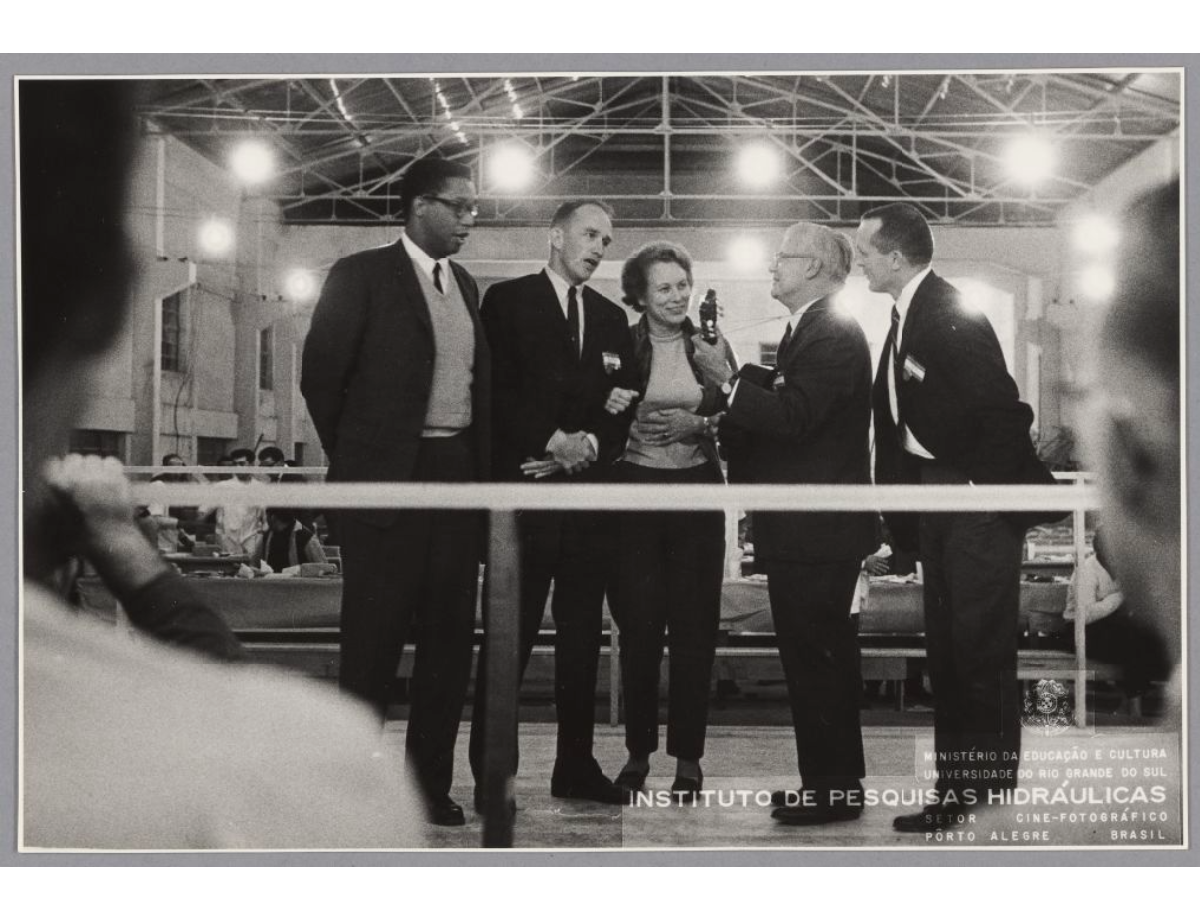
Arthur T. Ippen (2nd from right) singing American folk songs and playing guitar beside his wife Ruth Ippen, alongside (left to right) MIT professors Ronald T. McLaughlin, John Fisher Kennedy, and Peter S. Eagleson. Ministry of Education and Culture, University of Rio Grand Do Sul's Institute of Hydraulic Surveys [Ministerio Da Educada E Cultura, Universidade Do Rio Grande Do Sul, Institutio De Pesquias Hidraulicas Setor Cine-Fotografic]. Porto Alegre, Brazil, 12 August 1964.
Canadian-born Ronald Theodore McLaughlin was the second black faculty member appointed at MIT, following Joseph R. Applegate. In 1962, McLaughlin was one of the civil engineering department's first appointments in the field of water resources systems, and his environmental work there was later recognized to be innovative as alternative technologies for handling wastewater in rural areas gained prominence. At MIT, McLaughlin developed Environmental Water Systems (ENWATS), a consulting firm with a focus on international civil engineering projects mostly in Brazil and Colombia.
McLaughlin also devoted considerable time and effort on strategies to broaden MIT's role within the wider community, including the MIT Summer Day Camp in Science and Technology, which attempted to provide a novel educational experience for underprivileged youth in local neighborhoods. McLaughlin was promoted to associate professor in 1965, but took a leave of absence three years later, remaining on leave until his resignation from MIT in 1969.