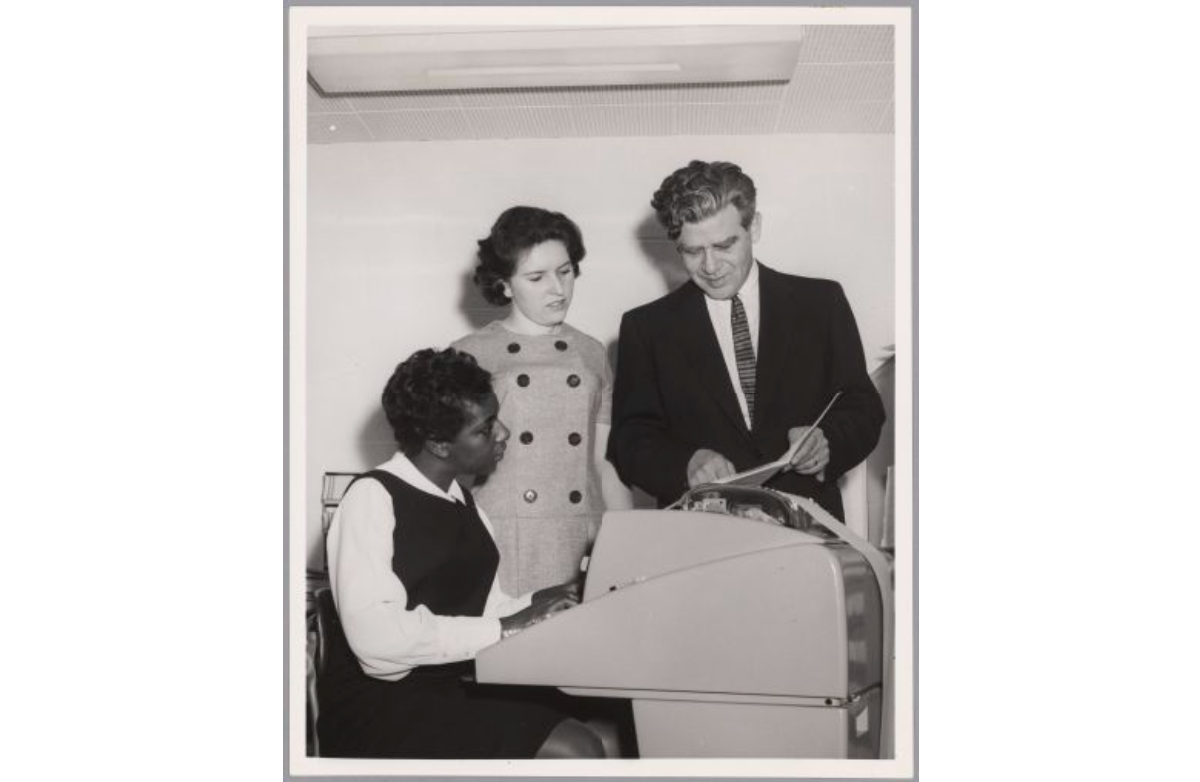
Whitney Young at the White House, 1964

Whitney Young sits at the Johnson White House. Washington, D.C., 18 January 1964.
Whitney Moore Young Jr. was born in 1921 just west of Louisville, Kentucky on the campus of Lincoln Institute—an African American high school where his father was head principal and president. Young graduated from the school as class valedictorian, before earning an undergraduate degree in social work from Kentucky State University in 1941.
During World War II, he was trained as an electrical engineer at [MIT]...After the war, Young earned a graduate degree in social work at University of Minnesota in 1947 and worked [with] the National Urban League [before serving] as dean of Clark Atlanta University’s social work program and [later being] elected president of Georgia NAACP...He studied at Harvard University under a Rockefeller Foundation grant.
[As] executive director of the National Urban League, taking charge of the organization as civil rights protests began to sweep across the United States [and pressing] major corporations to hire more African Americans.
A close ally of Martin Luther King Jr., Young helped organize the March on Washington and fostered closer relations within the federal government. Uninterested in entering politics himself, Young advised Presidents Kennedy and Johnson, and turned down a potential cabinet post offered by President-elect Richard Nixon.
"Boardroom Activist," 50 Years after Whitney Young, Jr. exhibit, American Institute of Architects, 2019