
William W. Cooke, ca. mid-1900s
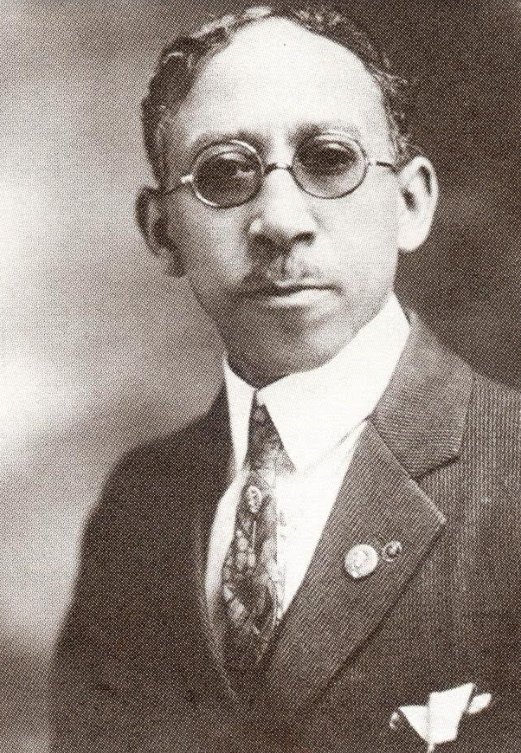
William Wilson Cooke, shown at the time he taught at Indiana University Northwest, Gary, IN, 1920.
was the first African American man employed to the office of the supervising architect at the United States Treasury Department.
He passed and was assigned to the office of the supervising architect at the United States Treasury Department, the first black man to be employed there. His initial appointment was as an architectural draftsman. After the war Cooke practiced architecture in Gary, Indiana. He was the first African American to obtain an Indiana state architect’s license (1929). William Wilson Cooke retired in 1941 and died on August 25, 1949.
His mother, Magdalena Walker, was a free woman of color before the Civil War.
Father owned a grocery store and a tannery
William Wilson Cooke [1871-1949] was born in Greenville, South Carolina. His father Wilson Cooke was a prominent local businessman, delegate to the 1868 South Carolina Constitutional Convention, and was formerly enslaved. At age 14, Cooke apprenticed to a carpenter. He later enrolled in Claflin University, where he took an architectural drawing course—the first such course taught at an historically black college and university (HBCU)—led by the pioneering instructor Robert Charles Bates. Upon completing his course of study at Claflin in 1893, Cooke spent the next 14 years closely engaged with Black higher education in the South. He taught at Claflin and the Georgia State Industrial College for Colored Youths (now Savannah State University), and designed many buildings for both institutions as well as other HBCUs.
Adapted from "Pioneering Black Architect William Wilson Cooke" by Jørgen Cleemann, GSA Blog, 24 February 2021
Cooke’s first job with the federal government began in 1907. Denied the right to take a civil service examination in the District of Columbia because of his race, he completed the three-day exam in Boston. When he reported for duty at the Office of the Supervising Architect in Washington, Cooke’s arrival disturbed staff members who had not known he was Black.
William Wilson Cooke (1871-1949) was born in Greenville, South Carolina. His father Wilson Cooke was a prominent local businessman, delegate to the 1868 South Carolina Constitutional Convention; William Cooke would later become the son-in-law of once-Congressman Thomas E. Miller. At 14 years of age, Cooke apprenticed as a carpenter. He later enrolled in Claflin University, where he took an architectural drawing course—the first such course taught at a historically black college and university (HBCU)—led by the pioneering instructor Robert Charles Bates. Upon completing his course of study at Claflin in 1893, Cooke spent the next 14 years closely engaged with Black higher education in the South. He taught at Claflin and the Georgia State Industrial College for Colored Youths (now Savannah State University), and designed many buildings for both institutions as well as other HBCUs.
Mr. William W. Cook was born at Greenville, S. C., in 1871. He graduated from the college department of Claflin University and taught the mechanic arts there and at Georgia State College. After a post-graduate course in the Massachusetts Institute of Technology he passed the examination for senior art draughtsman. In 1908 he was assigned to supervise the erection and completion of the post office at Lancaster, Pa., and since he has supervised work in four different states. At present he is supervising the new post office at Ashland, Ohio, which will cost with site $115,000. He has spent over $650,000 satisfactorily for the government. Mr. Cook is a son-in-law of Ex-Congressman Thomas E. Miller and has two children.
The Crisis 1917-05: Vol 14 Iss 1
https://archive.org/details/sim_crisis_1917-05_14_1/page/30/mode/2up?q=%22massachusetts+institute%22
https://blackthen.com/william-w-cooke-first-black-man-employed-u-s-treasury-department-supervising-architects-office/
https://www.philadelphiabuildings.org/pab/app/ar_display.cfm/736252
Born in Greenville, SC, to Wilson Cooke and Margaret Magdelena Walker Cooke, William Wilson Cooke began an apprecticeship as a carpenter in 1885. Hen enrolled in Claflin University in 1888 and undertook a class in architectural drawing taught by Robert Charles Bates. In 1893 he graduated from Claflin with a college preparatory diploma in liberal arts and then returned to Claflin as the assistant to Robert Charles Bates. In 1894 he became superintendent of the Industrial Department at the Georgia State Industrial College for Colored Youth (Savannah, GA). However, in 1897, Cooke returned to Claflin to replace Robert Charles Bates as the superintendent of manual training and industrial arts.
By 1900, although Cooke had already designed a number of buildings for Claflin University, he returned for further training in architecture to the Boston School of Technology, thereafter taking a course in art history at Columbia University. When he returned to Claflin, he took additional courses so that he could graduate with a B.S. in Technology in 1902.
After successfully taking the three-day federal civil service examination administered in Boston in March 1907, Cooke gained employment with the U.S. Treasury Department Supervising Architect's Office as an architectural draftsman. He would remain with the Supervising Architect's Office until 1918, but in 1909 he transferred to Field Operations, where he would supervise the construction of federal courthouses and post offices in Pennsylvania, Ohio, Illinois, and West Virginia. From 1918 to 1921 Cooke worked for the War Department as director of vocational guidance and training at Wilberforce University.
In 1921 Cooke entered private practice in Gary, Indiana, and he earned his state architect license in 1929. The crash of the stock market sorely affected Cooke's practice, and in 1931 he became a construction engineer with the Supervising Architect's Office, chiefly designing and overseeing construction of post offices in Ohio, Illinois, Missouri, Michigan, Wisconsin and Minnesota.