
Questions to MIT, 1968
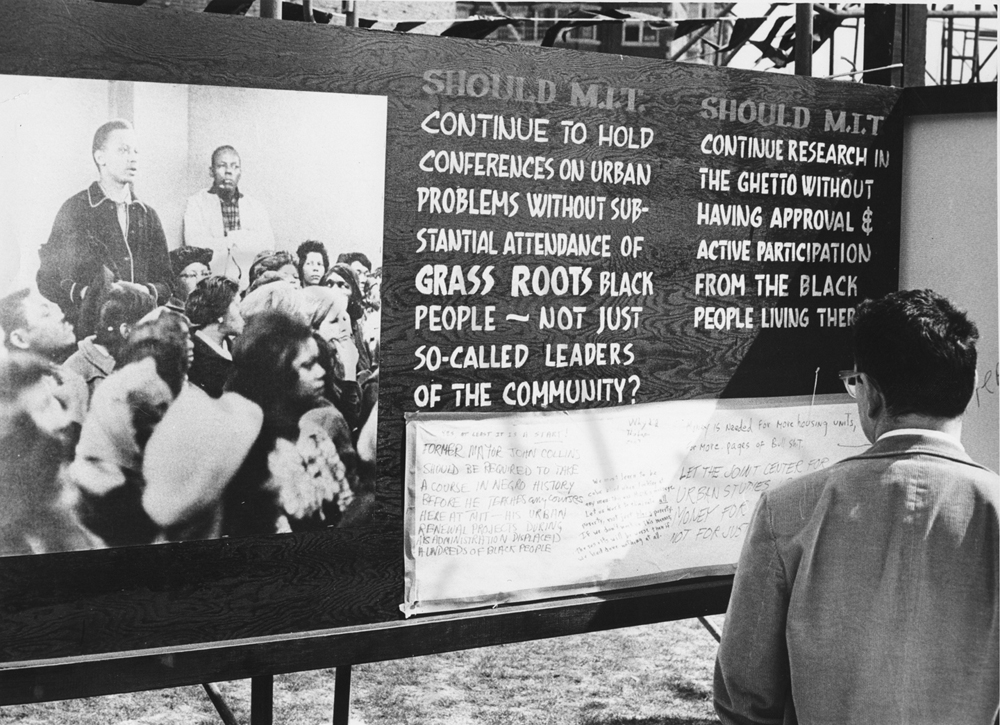
Exhibit near the MIT Student Center, 1968
Should MIT...
Continue to hold conferences on urban problems without substantial attendance of grassroots black people- not just so-called leaders of the community?
Continue research in the ghetto without having approval & active participation from the black people living there?"
Campus Climate
The assassinations of Martin Luther King, Jr. and President John F. Kennedy in 1968 sparked new initiatives towards making MIT a more equitable community. That year saw the formation of the Black Students' Union and Project Interphase, a summer program for incoming minority freshman.
Frank Sidney Jones was appointed director of the MIT Urban Systems Laboratory (1968-69) and in 1970 made tenure history after being named Jones Ford Professor of Urban Affairs and Planning.
Around this time, the Department of Urban Studies and Planning (DUSP) was capitalizing on the nation's climate of urgency about solving urban problems. A new Bachelor of Science in Urban Studies was being offered, along with the option of a five-year SB/MCP degree. Courses included educational planning, health planning, welfare policy, social program development and evaluation, poverty law and strategies for institutional change.
By 1974, increases in cost and cuts to funding began to affect DUSP's projects and research efforts. The department encouraged faculty to devote more time to sponsored research and initiated new contacts with the private sector.


