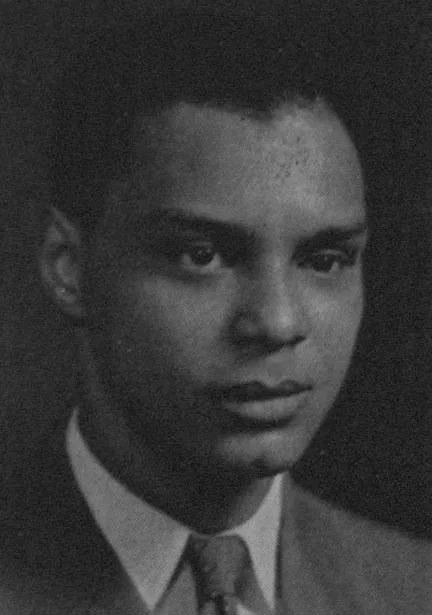
Edward Swain Hope sworn in as a Lieutenant, 1944
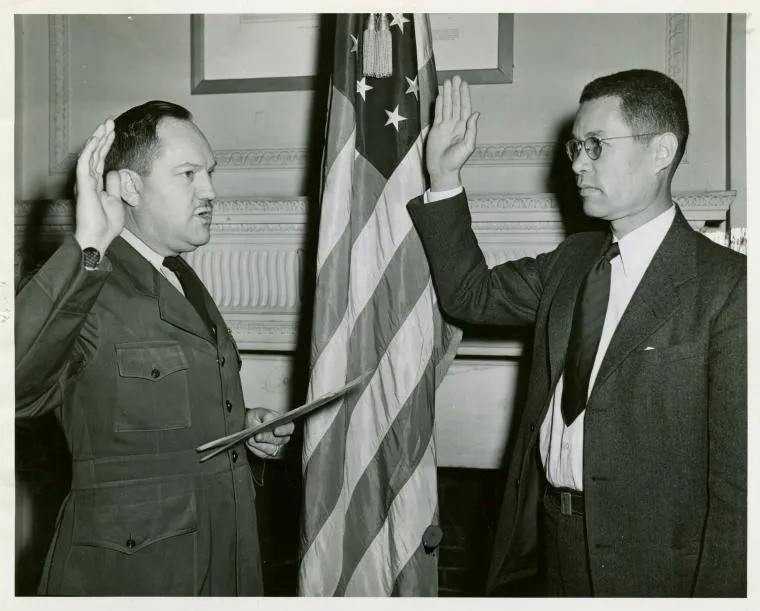
Edward Swain Hope of Washington, D. C., is sworn in as a Lieutenant, CEC-V(S), USNR by Lieutenant Commander H.B. Atkinson, USNR, Executive Officer of the Office of Naval Officer Procurement of Washington; he was then ordered to proceed to U.S. Naval Construction Training Center at Davisville, Rhode Island for introduction and assignment to duty on the station force in connection with Seabee training. Washington, D.C., 15 May 1944.
Edward Swain Hope '26, SM '27 was the son of longtime Morehouse College president John Hope. At MIT, he was a member of the Civil Engineering Society and on November 19, 1925 pledged Alpha Phi Alpha, Sigma Chapter, with MIT classmate William H. Bethel '27.
After graduation, Hope traveled to Grenfell Settlement in Newfoundland to perform "the very difficult task" of installing a water supply, with three assistants working under him--one from Harvard and two from Yale--according to The Crisis (Vol. 32, Iss 4, Aug. 1926). From 1932 to 1944, he served as Howard University’s superintendent of building and grounds before joining the faculty as professor of civil engineering in 1947 along with fellow MIT alum Lee Julian Purnell '21. In 1944, Hope became the first Black Navy lieutenant. He left the United States in the 1950s to serve as chair of the civil engineering department at the University of Lebanon in Beirut.